The Gamification of Science in Sandbox Games and its Role in Education
Play Futures A03 | s4008878
Sandbox Games usually are not considered 'games', but a virtual world that provides unlimited creative freedom for its players. This allows a variety of possibilities on ways to manipulate this tool for different purposes which can be entertainment content, experiments, or education. My project will be focusing on the educational aspects of these games; how players engage with its content, and how teachers utilise Sandboxes for teaching subjects like STEM.Sandboxes are a powerful tool to encourage player curiosity and learning, whether it’s to teach someone the wonders of the universe, how physics work, or even utilise it for worldbuilding and training tools. I find science in games fascinating with how scientists and programmers work together to create something as scientifically accurate as possible to teach players with a curious mind as well as be used for other research purposes.
RESEARCH
While my project focuses on the STEM aspects of education in Sandbox games, I looked into astronomy games like Kerbal Space Program and Universe Sandbox to seek ways those games have been used for teaching and in a way, 'gamify' science/learning for a fun interactive environment.In the academic article Design of space systems and operational mission architectures using sandbox games (2025) by Rodrigo N. Schmitt et. al, it discusses how despite limitations, Kerbal Space Program modifications allow players to modify the game's mechanics for additional realism and create a sustainable rocket prototype for cislunar missions. Qualified engineers were working on this project and stated mods like KRPC API "integrated into a broader SoS architecture, providing insights into the operational efficiency and overall system complexity."( Rodrigo N. Schmitt et. al). The realism KSP provides ensures efficiency and accuracy in developing rocket concepts for those qualified and learning, which can be used for educational purposes as the physics and mathematics provided prompts critical thinking for players who aim to concept a realistic rocket that could potentially be used in space research. However, due to the limitations of the game, it can kill immersion for players seeking a sense of realism for their project/experiments, but fortunately the freedom of the game allows modifications to improve realism for greater immersion.

Fig. 1. Kerbal Remote Procedure Call representation of a vessel in parts. Image derived from academic website.
The Routledge Companion to Video Game Studies - 49 EDUCATION by Richard E. Ferdig and Enrico Gandolf states how the growing love for video games connect with player immersion in education by utilising games like Unity, Roblox, and Scratch to build environments remotely or in person such as a school environment. The text connects "learning" with "doing", as stated from “video game play (consumption) provides a point of interaction between learning and doing” ( Ferdig, 2012a, p. 179) and how what players learn (action, behaviour) influence their 'doing'. This can come with both negative and positive contexts; for example, players can 'learn' violence from violent games which causes aggression in their behaviour, but players can also learn academic material and apply it to their critical thinking skills via a virtual environment.
“individuals feel free to express themselves (Jung, 2020 ). In addition, studies have offered evidence that online game outlets facilitate cognitive and knowledge transfer processes supporting collaborative and critical thinking (Gandolfi, 2022 ).”

Fig. 2. 'Roblox Education Webinars - Roblox Training for Teachers Ages 8 - 12' by Roblox on Youtube
Simulation-Based Training via a “Readymade” Virtual World Platform: Teaching and Learning With Minecraft Education by Simon Bourdeau et.al discusses how a sandbox game like Minecraft can be used by a team of students or employees to make custom virtual environments for educational purposes and how immersion is directly linked to a motivation to learn. Minecraft focused solely on playing the game as it didn't involve a sense of progression, competition, or leaderboard systems compared to many multiplayer games, which provided ease in how players developed their own worlds. Additionally, teachers also add to the gamification aspects by providing prompts and implementing game-like features like quests and goals; this evident when students were tasked to develop Olympic structures with dedicated stories in Minecraft to teach players in an immersive environment as the text states this technique "stimulate participants’ motivation; bring classrooms closer to “real-life” situations; create realistic, stimulating, manageable, safe, and risk-free environments; favor team development; and, when compared with “traditional” techniques, accelerate knowledge integration and recall."(Simon Bourdeau et.al). By creating a virtual world that inform players of something, the immersion of their environment and freedom allow a more engaging classroom environment within a virtual world.

Fig. 3. Minecraft Education's chemistry feature
Game immersion experience: its hierarchical structure and impact on game-based science learning by M.-T. Cheng, H.-C. She, L.A. explains how "fun/excitement and cathartic elements highly motivate players" (Ferguson & Olson, 2013) to the point "players can become so absorbed in the games that their perceptions may become distorted to a certain degree". Motivation in this context refers to a player's 'flow state' but in an academic sense that stems from game immersion. This motivation is considered "the motivation to learn" which the article states is achieved via player input. This allows scientific concepts to be easily understood when portrayed in a virtual world rather than a classroom environment, and how it all connects back to immersion that derives from the player input.
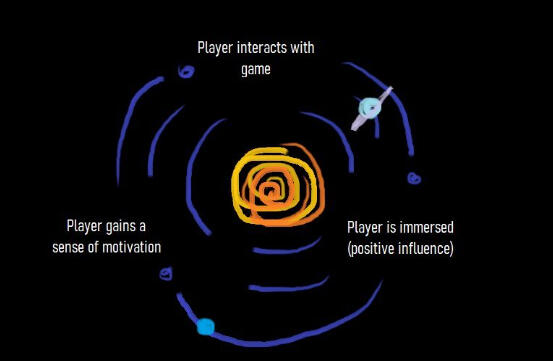
Fig. 4. My loop based on motivation and influence, designed like a 'game loop'
SUMMARY / CONCLUSION
Sandbox games are an efficient learning tool for mimicking classroom environments in an immersive virtual world designed by both teachers and students. To be motivated to learn, players would need to seek immersion in their world; this could consider game design, freedom, realism, physics, audio, etc. In Kerbal Space Program, engineers found immersion in its sense of realism, but the limitations prompted players to seek modifications to improve the physics which allowed the engineers to concept cislunar rockets. This idea of immersion -> motivation to learn also connects to player input and learning as players learn behaviours/information in games or other media, then apply this knowledge into their education like an influence. This brings them into a 'flow-state' and immerses them in their virtual world, that they are 'in charge' of their world and while they are applying their critical thinking skills or working as a team, they are learning something different than in a class environment whilst also developing better teamwork skills in multi-player games like Minecraft. The freedom and lack of gameplay elements allow unrestricted creativity in developing a new but immersive environment for students and teachers to enjoy, while games like Kerbal Space Program provides realistic simulations targeted towards STEM students, teachers, qualified professionals, and those wanting to expand their curiosity in science.
METHODS
I chose to run a survey and personal interviews with players who engage with Sandbox games like Kerbal Space Program, Universe Sandbox 2, and Minecraft. For interviews I spoke to both students and teachers including an assistant teacher to gain a variety of perspectives, but in my survey I aimed for a more general audience.
> Survey
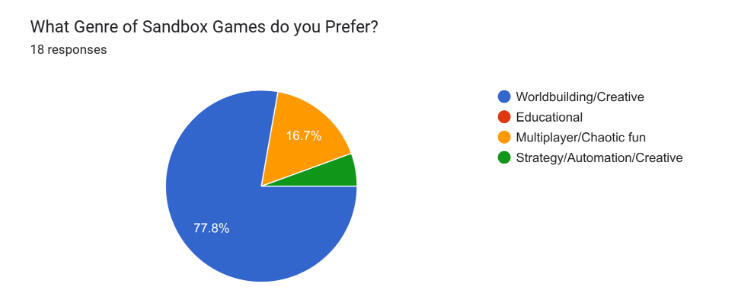
Fig. 1. General survey on how players engage with Sandbox games
I ran a general survey on how players engage with sandbox games and their intentions with their creative freedom. 77.8% of responders preferred worldbuilding/creative games for reasons like creating stories, making the impossible 'possible', as players have written why they come back to Sandboxes:
"well, it is pretty fun to fuck around and do shit, especially when there are things that shouldnt be possible yet here we are""Because of how open and free they can be. They can be unique outlets for creativity and random fun that no other game genre can provide.""The gameplay and how limitless they are. The less restrictions i have and if i have the power to do nearly whatever i want and come up fantasies, then i'm more likely to return to a sandbox game."
Additionally, players return back to Sandbox games not just for creativity and worldbuilding purposes, but to also try "new ideas like following a tutorial or running a simulation to see what happens". Experimenting in Sandboxes is not a new concept, and it's commonly found in Minecraft challenges/mods and STEM games like Kerbal Space Program, Space Engine, and Universe Sandbox.Players also found interest in the adventure of these genre of games, how they demonstrate "experiences that you don't experience in real life situations" which contributes to their immersion meter.My final question was if players think Sandboxes can be used as an educational tool, which 100% of participants voted 'yes'.
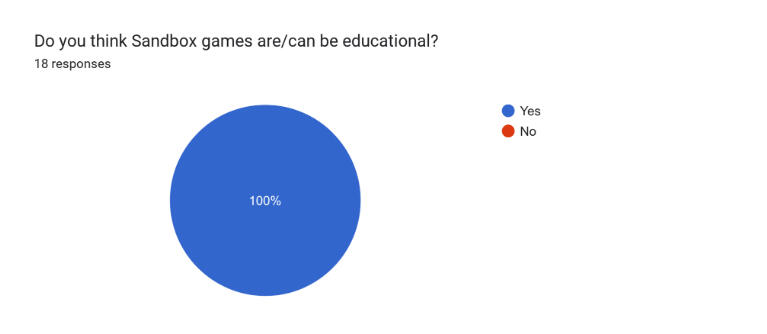
Fig. 2. 100% of votes for Sandbox games being education
> Student Interviews
I conducted a total of 5 interviews, some involved students. I decided to interview students because they are the ones learning and engaging with the material which would provide me more personal responses in how they immersed themselves in their virtual world to learn STEM topics.I interviewed STEM and hobbyist students who actively engage with sandboxes such as Kerbal Space Program and Universe Sandbox 2. Multiple interviewees stated the realism KSP and Universe Sandbox 2 provided was highly engaging and taught them fundamental topics on aerospace engineering, piloting/building ships, understanding deltaV, and orbital mechanics. One of my interviewees even stated "having a professor explain deltaV and orbital mechanics in class is very boring - experiencing it in-game watching rockets collide and space stations dock is very cool".Another interviewee also mentioned intractability in sandboxes, how that taught them within an immersive environment: "most of us have at least a slight conceptual and intuitive understanding of how the universe works. But these games allow us to see them interact, thereby revoking their conceptual status, and grounding them enough to create an impact for education". This supports the idea of how immersion impacts the motivation to learn, as discussed in Game immersion experience: its hierarchical structure and impact on game-based science learning by M.-T. Cheng, H.-C. She, L.A. as it explains how players enter a flow state known as immersion which directly influences their motivation to interact with the virtual world to learn concepts.From my interviews with students, I understand that games would need to be informative and immersive whilst also providing relevant interaction elements.
> Teacher Interview
I also conducted interviews with teachers including an assistant teacher. My interview with them were about Minecraft (Vanilla and Education) and how they applied this sandbox in a learning environment. They both stated the Minecraft command block was useful in teaching kids how to program whilst also being provided the freedom to explore and immerse themselves into the world. They also stated that Minecraft Education was more "visually stimulating and interactive" which can prove useful in teaching younger students because "sometimes it’s better to simplify things in teaching than be fancy with jargon". However, of my interviewees, a design teacher stated that Minecraft as a learning tool "seems good for the younger ages eg 7, 8, 9, but too old for older ages" due to its stimulating design potentially aimed at younger audiences. Another obstacle was its graphics making it harder to grade and immerse students, especially in video recording due to pixelation, but the low graphics did improve performance by providing lag-less gameplay which contributes to the fun.The tools for Minecraft as stated by both teachers were "efficient as most of the tools were there ready to go", and this learning tool also encouraged independence in students as "instructions were straightforward and students were able to also be independent". As Minecraft is a multi-player game, it also improved teamwork between students. Minecraft was also "universally easy to use" so not many instructions were needed to be given.Using Minecraft as a learning tool shows stimulating and engaging worlds with simple straight-forward responses.
OBSERVATIONS
By observing Youtube content featuring Sandbox games followed by games by NASA, I gain a better understanding on how players engage with the planet properties, how they understand the planet's composition to create something new.
> Terraforming the Moon:
This video is in a Youtube Shorts format where it uses Universe Sandbox to demonstrate their experiment. Using real physics simulations the game provides, the youtuber utilises those settings to turn the Earth uninhabitable before moving onto the moon and giving it an atmosphere and the right amount of nitrogen and oxygen for life to develop. Although in the form of a short video, it briefly educates viewers on how to make any celestial body habitable with the right settings needed. Further, the snappyness of the video also holds engagement from viewers.
@when-the-hrandomstuff 6 months ago
"Finally someone remembers the magnetic field!"@Daviticus042 4 months ago
"Actually, once you get rid of the atmosphere draining the oceans will take care of itself because without any air pressure the water will boil away, even though it's not any hotter."@Ayushman-7v2 6 months ago
"NASA seeing this taking notes"

Fig. 1. Terraforming the moon
> How to Create Habitable Planets in Universe Sandbox:
Using Universe Sandbox as a learning/tutorial material teaches viewers on how habitable planets exist and the properties it needs for it to survive. The creator teaches players the basics of the Sandbox like spawning stars and adding in objects to create any habitable planets as long as it follows the same properties such as orbiting a single star, being in the goldilocks zone, and having the right atmosphere and gravity.
@ 2 years ago
"To be honest, this is the best tutorial of making habitable planets i've ever seen!"@ 2 years ago
"How I accidentally made a habitable planet: failed to make the moon not crash into Mars. Result: Planet becomes habitable due to temperature rising."@ 3 years ago
"I wish planetscaping could be used on a 2D projection so you wouldn’t get lost so much"

Fig. 2. How to Create Habitable Planets in Universe Sandbox
> Realistically Creating the Solar System in Universe Sandbox:
The player in this video recreates the solar system in a realistic manner that reflects what may have truly happened in the universe. As the description states; “We use science and explosions to remake our wonderful solar system, from Sol to Earth. Obviously much is cut, simplified, or unable to be simulated by a game - but it's still a good summary!” Universe Sandbox’s realistic mechanics proves useful for recording videos on how to rebuild the Solar System as real as possible due to its realistic physics and simulations.
@ 5 years ago
"I learnt more about planets in this video than 5 years in school"@ 7 years ago
"This is the most realistic thing iv'e ever seen"@ 7 years ago
"Why do I feel like every time he says “realistically” it’s not really realistic?"

Fig. 3. Realistically Creating the Solar System in Universe Sandbox
NASA GAMES
> Explore Mars: A Mars Rover Game
Explore Mars: A Mars Rover Game was developed by NASA in 2020-2023. It is a simple game where you add controls to the control panel to do research expeditions as the Mars Perseverance rover. Although you don't receive any additional information on what you have studied, the description of the game does show real data discovered by the Perseverance rover to educate any curious minds when playing the game. The game itself isn't very educational, but the control system does provide a bit of uniqueness for a kids game.

Fig. 4. Explore Mars: A Mars Rover Game made by NASA
> DSN Uplink-Downlink: A DSN Game
DSN Uplink-Downlink: A DSN Game is a short game created by NASA where you play as a DSN by using the arrow keys or AD to aim the satellite and shoot/receive data from satellites outside of Earth. The difficulty provides fun and challenge whilst also providing a simple idea on how DSN receives and transmit data to satellites outside of the Earth.

Fig. 5. DSN Uplink-Downlink: A DSN Game
> CubeSat Builder: Build a NASA Spacecraft!
CubeSat Builder: Build a NASA Spacecraft! is a short 3D game developed by NASA where you build a CubeSat in under 3 minutes. The tutorial goes through what a CubeSat is and what parts make it function. In gameplay, there is a list of items you need to retrieve in order to build the CubeSat which provides additional information on how these machines are formed. The speedrunning nature also makes this game very engaging. The third person top down view also reminds me of Overcooked.

Fig. 5. CubeSat Builder: Build a NASA Spacecraft!
FINAL DELIVERY
My final delivery is this website followed by a very short and simple "game" about Voyager 2's trajectory towards the Jovian planets. I wanted to aim for something simple but immersive at the same time as you are viewing everything in Voyager 2's perspective whilst also clicking on rotating planets to learn more about the celestial body whilst reading Voyager 2's discoveries. There is no gameplay elements as I also wanted to reference how sandbox games aren't considered games, but I also did not have the skill or time to develop a sandbox or something similar myself, so I decided to make a walking sim-like game with information. This "game" could be used for educational presentations, or for someone who wants a quick fact about the Jovian planets.Using Blender, I 3D modelled and texture painted the Jovian planets and gave them their respective tilt and rotation animation. Initially, I planned to create the entire 8 planets (+ Pluto), but I decided I wanted to focus on Voyager 2 who mainly focused on the Jovian planets (Jupiter, Saturn, Uranus, Neptune).I based the direction based off of Voyager 2's pathway:

Fig. 2. Voyager 1 and 2 trajectory
> Video Recording
REFERENCES
> Schmitt, R. N., Becker, M. F., DeLaurentis, D., & Oguri, K. (2025). Design of space systems and operational mission architectures using sandbox games. Acta Astronautica, 234, 41–58. https://doi.org/10.1016/j.actaastro.2025.04.004> Richard E. Ferdig and Enrico Gandolfi (2023). The Routledge Companion to Video Game Studies.
https://ebookcentral.proquest.com/lib/rmit/reader.action?docID=31174462&ppg=648&c=RVBVQg> Bourdeau, S., Coulon, T., & Petit, M.-C. (2021). Simulation-Based Training via a “Readymade” Virtual World Platform: Teaching and Learning With Minecraft Education. IT Professional, 23(2), 33–39. https://doi.org/10.1109/mitp.2021.3062935> Cheng, M.-T. ., She, H.-C. ., & Annetta, L. A. (2014). Game immersion experience: its hierarchical structure and impact on game-based science learning. Journal of Computer Assisted Learning, 31(3), 232–253. https://doi.org/10.1111/jcal.12066> Terraforming the moon: https://www.youtube.com/shorts/LqdCdMsi97A> How to Create Habitable Planets in Universe Sandbox: https://youtu.be/wzSJb-VksLY?si=IHIBMigBwyxLGukl> Realistically Creating the Solar System in Universe Sandbox: https://youtu.be/Lxy2My9B47M?si=uzolvxcqt7A6pWKe> NASA. (2019). Explore Mars: A Mars Rover Game | NASA Space Place – NASA Science for Kids. Nasa.gov. https://spaceplace.nasa.gov/explore-mars/en/> DSN Uplink-Downlink: A DSN Game | NASA Space Place – NASA Science for Kids. (n.d.). Spaceplace.nasa.gov. https://spaceplace.nasa.gov/dsn-game/en/
> CubeSat Builder: Build a NASA Spacecraft! | NASA Space Place – NASA Science for Kids. (2017). Nasa.gov. https://spaceplace.nasa.gov/cubesat-builder-game/en/> Then There Were Two: Voyager 2 Reaches Interstellar Space. (2018). NASA Jet Propulsion Laboratory (JPL). https://www.jpl.nasa.gov/edu/resources/teachable-moment/then-there-were-two-voyager-2-reaches-interstellar-space/> NASA. (2024). Voyager 2 - NASA Science. Science.nasa.gov. https://science.nasa.gov/mission/voyager/voyager-2/> NASA. (2024). Jupiter - NASA Science. Science.nasa.gov. https://science.nasa.gov/jupiter/> NASA. (2024). Saturn - NASA Science. Science.nasa.gov; NASA. https://science.nasa.gov/saturn/> NASA. (2024). Uranus - NASA Science. Science.nasa.gov. https://science.nasa.gov/uranus/> NASA. (2023). Neptune - NASA Science. Science.nasa.gov. https://science.nasa.gov/neptune/> Space Cinematic Ambient Free Music No Copyright: https://youtu.be/ozb32hgHdo4?si=ZxTefD-z8XDlSCp6> Slowest Camera Click.wav:
https://freesound.org/people/theplax/sounds/624922/> Real Stars Skybox Lite by Geoff Dallimore:
https://assetstore.unity.com/packages/3d/environments/sci-fi/real-stars-skybox-lite-116333?srsltid=AfmBOorsnGbLg3rsvbaViRSBgHOB4b2R09ngz6EOSXqyzY2_VQy42GOo